 Dan · Editor, 3.5 DUPR player · How we score
Best Power Pickleball Paddles
A power paddle is built to send the ball back faster than you swing it. That extra pace wins points on serves, returns and drives, but leaves less margin at the kitchen, so the best power paddles add pop without making the soft game a guessing game. We rank every paddle from the maker’s published specs on one public scale, and these ten rate highest for power.
Most of that power comes from how a paddle is built. Thinner cores and foam cores send the ball off the face with more pop, while thicker honeycomb cores trade a little pace for control. Longer, elongated shapes and heavier weights carry more speed through the ball, and a longer handle leaves room for two-handed backhands. The ten paddles below put those pieces together in different ways, from all-foam builds to thin honeycomb cores, so there’s a power paddle here for most games.
The 10 Best Pickleball Paddles for Power, Ranked
From our top pick down, with what each paddle is built from and the kind of player it suits.
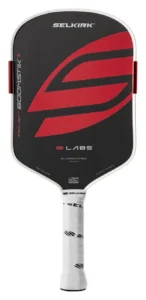
Sale9.3/10Elongated #1 · Best power pickleball paddle
Selkirk built the Boomstik for one job: hitting the ball hard. It pairs Selkirk’s BoomCore, a PureFoam core wrapped in an EVA power ring, with a three-layer carbon face and Selkirk’s InfiniGrit surface, and it rates at the top of our scale for both power and spin.
It’s on the heavier, more stable side, and its long handle leaves plenty of room for a two-handed backhand. It suits an aggressive intermediate or advanced player who attacks from the baseline and transition zone.
9.1/10Elongated 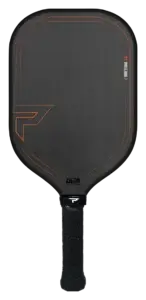
#2 · Runner-up: best power pickleball paddle for advanced players
Paddletek’s Honeyfoam TKO-X layers three foams: an EPP foam core, an EVA foam wrap and a foam ring around the perimeter, under a raw carbon face. That build matches our top pick for power and spin.
It’s elongated with a long handle and swings a touch quicker than the Boomstik. It suits power players and former tennis players who want reach and foam-core pop.
9.1/10Elongated 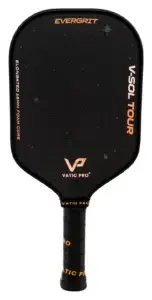
#3 · Power and control
Vatic Pro’s V-Sol Tour Elongated floats an EPP foam core inside an EVA foam perimeter ring, under a textured carbon face. Like the two above it, it rates at the top of our scale for power and spin.
Vatic Pro publishes its full weight and balance figures, and you’ll find them all in the spec table on our review.
9.1/10Elongated 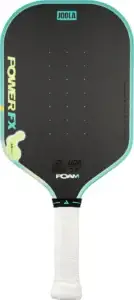
#4 · Foam core pickleball paddle
The Perseus is JOOLA’s elongated line, and the POWER FX version turns it into a full foam-core paddle: an EPP foam core with JOOLA’s extended Propulsion Core under a textured carbon face. It rates at the top of our scale for power and spin.
The trade-off is a slightly smaller sweet spot than the paddles above it. It suits an aggressive intermediate or advanced player who already likes the Perseus shape and wants more pop from it.
9.1/10Elongated 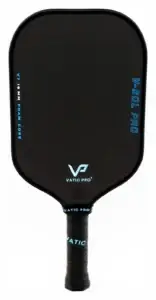
#5 · Heavyweight power
The V-Sol Pro V7 uses the same floating EPP foam core and EVA ring as the V-Sol Tour, under a raw Toray carbon face with heat-compressed texturing. It rates at the top of our scale for power and spin.
It’s one of the heaviest paddles we review, which adds stability on drives and blocks, yet Vatic Pro lists a moderate swing weight. A long-handle version is available for two-handed backhands.
9.0/10Elongated 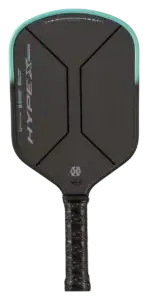
#6 · Thin-core power (14 mm)
Onix’s Hype X Pro takes a different route to power: a thinner polypropylene honeycomb core than the foam paddles above, under a raw carbon face. Thinner cores add pop, and it rates at the top of our scale for power and spin.
Control is its weaker side, the usual cost of a thin core. It suits intermediate players moving into league play who want raw-carbon spin and pop in an elongated shape.
9.0/10Elongated 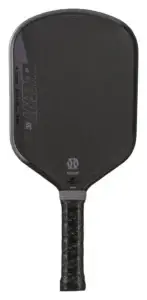
#7 · Pickleball paddle for two-handed backhand
The Lucent RC pairs a thin Hexcell polypropylene core with Onix’s Dual Action raw carbon face, and it rates at the top of our scale for power and spin. Its standout feature is the handle: long, and built like a tennis grip.
That long handle makes it a paddle for two-handed backhands, and it suits experienced players who want extra reach. Like the Hype X Pro, control is its weaker side, so it rewards a player who already has a steady soft game.
9.0/10Elongated 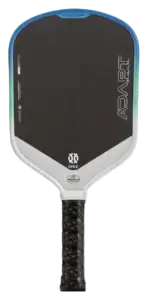
#8 · Power and spin
The Adapt Max mixes both core types: a thin polypropylene core with foam built into its inner perimeter, under a raw carbon face with Onix’s MAXRev surface texture. It rates at the top of our scale for power and spin.
It suits spin-focused intermediate and advanced players who want reach and pop. It’s newer than most paddles here, so it has fewer buyer reviews so far.
Sale9.0/10Hybrid 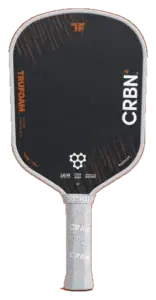
#9 · Hybrid shape pickleball paddle
The only hybrid shape in this ten. CRBN’s Barrage uses a thinner floating foam core with an EVA perimeter ring under raw carbon, in CRBN’s AeroCurve hybrid outline, and it rates at the top of our scale for power.
It’s one of the lightest-swinging paddles here, which suits doubles players who attack in fast hands battles at the kitchen.
Read our full review of the CRBN⁴ TruFoam Barrage (Hybrid, AeroCurve)
Sale8.9/10Elongated 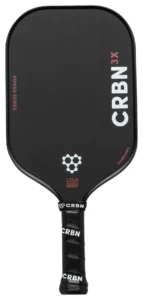
#10 · Unibody pickleball paddle
CRBN’s X Series is a one-piece (unibody) carbon paddle with a polypropylene core and a foam-reinforced perimeter, under a gritty carbon face. It comes in two thicknesses, and we score the thinner one, which rates at the top of our scale for power and spin.
Its shorter handle sets it up for one-handed players.