Swing Weight vs Twist Weight: Pickleball Paddles Explained
Edited by Dan · Published · Updated · How we research
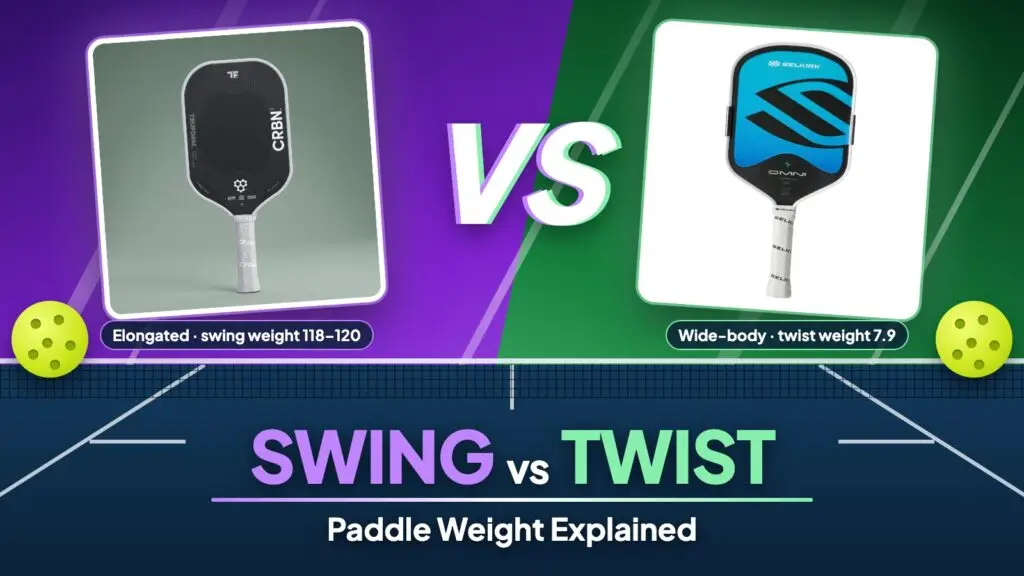
Two paddles can weigh exactly the same and feel completely different in your hand. Static weight only tells you how heavy a paddle is on a scale. Swing weight and twist weight tell you how it behaves when you move it and when the ball hits it off-center. This guide explains both, using the figures brands publish. We haven’t play-tested these paddles.
Quick Answer
- Swing weight describes how heavy a paddle feels when you swing it. Higher means more momentum and plow-through; lower means quicker hands.
- Twist weight describes how much a paddle resists twisting when the ball hits away from the center. Higher means more stability and a more forgiving sweet spot.
- Balance point is where the paddle balances along its length. A higher balance point (more head-heavy) usually raises swing weight.
Swing Weight
Swing weight measures how the paddle’s mass is spread along its length, relative to your hand. Mass near the tip counts far more than mass near the handle, so a longer or more head-heavy paddle has a higher swing weight even at the same total weight. High swing weight adds power and stability on drives; low swing weight makes a paddle faster in hand battles at the kitchen.
CRBN’s numbers show how much shape matters. The hybrid Genesis⁴ and the elongated Genesis³ have the same 8.1 oz average weight, but CRBN lists swing weights of 106–108 for the hybrid and 118–120 for the elongated shape.
Twist Weight
Twist weight measures resistance to rotation around the paddle’s long axis, which is what happens when the ball strikes toward the edge. Wider faces and mass placed toward the sides raise it. A higher twist weight keeps the face steadier on mishits, which is why wide-body paddles feel more forgiving. CRBN’s long-handle Genesis¹, its narrowest shape at 7.35 in, has the lowest twist weight in its range (5.75); 11SIX24’s wide-body Pegasus Power 2 has the highest in its line (7–7.25).
Published Figures From Our Reviews
These figures come straight from each manufacturer. Compare paddles within the same brand only (see the next section).
| Paddle | Weight | Swing weight | Twist weight |
|---|---|---|---|
| CRBN⁴ TruFoam Genesis (hybrid) | 8.1 oz avg | 106–108 | 6.58 |
| CRBN⁴ TruFoam Barrage (hybrid) | 8.0 oz avg | 108–110 | 6.50 |
| CRBN⁴ TruFoam Waves (hybrid) | 8.0 oz avg | 111–113 | 6.68 |
| CRBN³ TruFoam Genesis (elongated) | 8.1 oz avg | 118–120 | 6.21 |
| CRBN¹ TruFoam Genesis (long handle) | 8.0 oz avg | 118–120 | 5.75 |
| 11SIX24 Pegasus Power 2 (wide body) | 8.0–8.3 oz | 105–110 | 7–7.25 |
| 11SIX24 Vapor Power 2 (hybrid) | 8.0–8.3 oz | 108–112 | 6.6–6.8 |
| 11SIX24 Hurache-X Power 2 (elongated) | 8.0–8.3 oz | 114–118 | 6.25–6.5 |
Why You Can’t Compare Brands Directly
There’s no single industry standard for how swing and twist weight are measured or reported. CRBN, 11SIX24 and Selkirk list swing weights of roughly 105 to 120, while HEAD lists a swing weight of 85 for its Gravity PRO EX15, which suggests a different measuring method rather than a far lighter-swinging paddle. Several brands, including JOOLA and Onix, don’t publish swing or twist weight at all. Use the numbers to compare shapes within one brand, not across brands.
Changing Swing and Twist Weight Yourself
Many players fine-tune a paddle with lead tape or weights:
- Adding weight near the top of the head raises swing weight and power.
- Adding weight on the sides of the head raises twist weight and stability.
- Adding weight near the handle raises static weight with little change to swing weight.
Some paddles build this in: Selkirk’s OMNI has removable perimeter weights to shift the balance, and CRBN sells lead tape strips and counter coins for customizing. Small changes make a noticeable difference, so add weight gradually.
Which Numbers Should You Look For?
- Fast hands at the kitchen: a lower swing weight, usually a hybrid or wide-body shape.
- Power and plow-through: a higher swing weight, usually an elongated shape.
- Forgiveness on mishits: a higher twist weight, usually a wider face.
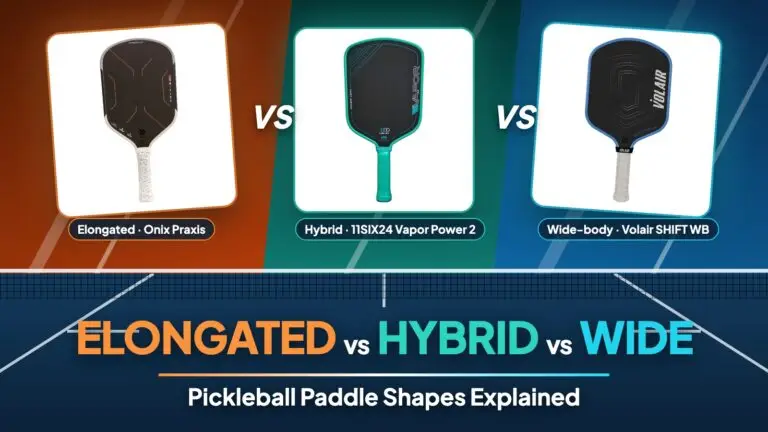
See how shape drives these numbers in paddle shapes explained, or compare paddles in the comparison tool.
Frequently Asked Questions
What is swing weight on a pickleball paddle?
Swing weight describes how heavy a paddle feels when you swing it, based on how its mass is spread along its length. Higher swing weight adds momentum and power; lower swing weight makes the paddle quicker in hand battles.
What is twist weight on a pickleball paddle?
Twist weight describes how much a paddle resists twisting when the ball hits away from the center. Higher twist weight means more stability and a more forgiving sweet spot.
Is a higher swing weight better?
Not necessarily. Higher swing weight suits power and baseline play; lower swing weight suits fast exchanges at the kitchen. Many doubles players prefer a lower swing weight with a high twist weight.
Can I compare swing weights between brands?
Not reliably. Brands measure and report swing and twist weight differently, and some don't publish them at all. Compare shapes within one brand instead.
Keep Reading

Next Step
Ready to Compare Paddles?
Put the paddles from any guide side by side and compare them on the same research scale.